 Expat Insiders
 Where and how to live
The first real decision you'll make in Hyderabad, and the one everyone asks about most: which part of the city, what kind of home, how to furnish it, and who helps you run it day to day.
Areas where expats live
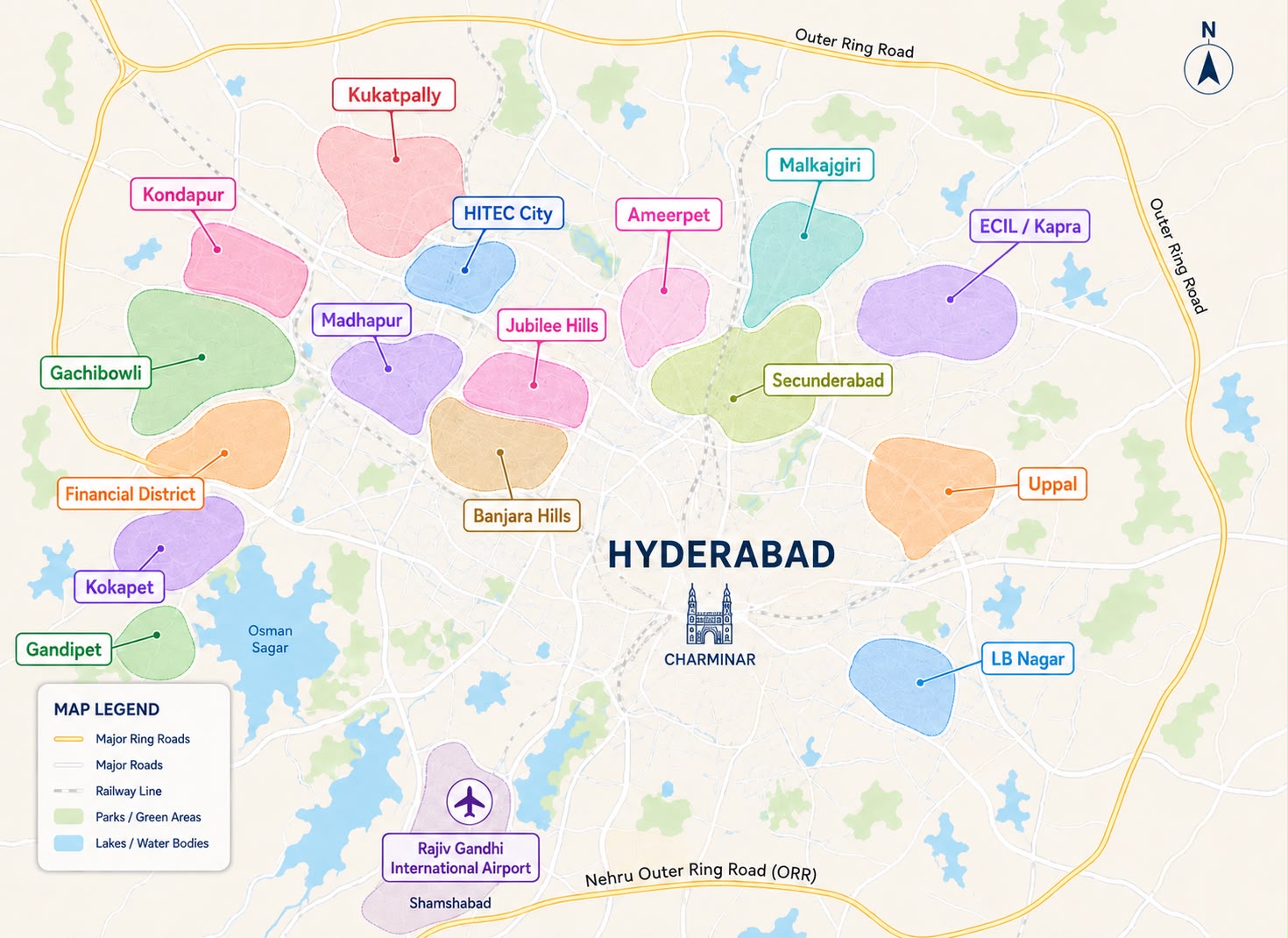
Most international arrivals settle in the western part of the city, close to the IT corridor and international schools. Click an area to see the neighborhoods and communities within it.
The map below shows where these areas sit relative to the rest of Hyderabad — useful for getting a feel for commute times and how close (or far) each option is from the old city and the airport.
Jubilee Hills & Banjara Hills
Established and leafy, closer to the older city and its restaurant scene. Longer commute to the IT corridor, but more character and mature infrastructure than the newer western suburbs.
- Add specific neighborhoods, roads, or communities within this area — e.g. Road No. 10, Film Nagar, specific apartment complexes.
Gachibowli & Kondapur
The heart of the expat and tech population. Good density of international grocery stores, clinics, and schools, with a short commute to most IT campuses.
- Add specific neighborhoods or apartment communities here — e.g. Nallagandla, Gopanpally, specific gated communities people recommend.
Financial District & Nanakramguda
Newer high-rises, shortest commute if you're working in that cluster. Fewer established street markets, but new retail is catching up fast.
- Add specific towers or communities here.
Kokapet & Narsingi
Quieter, more villa-style communities, popular with families wanting more space. Still developing in terms of everyday retail and services nearby.
- Add specific villa communities or societies here.
Where expats live is usually driven by commute and school pickup zones more than anything else — settle those two first and the neighborhood shortlist narrows itself fast.
Housing structure
Three housing formats cover most of what's on the market for expats. Each comes with real tradeoffs worth weighing against your household's priorities.
Apartment in a community
A flat inside a larger residential complex — the lowest-maintenance option, and typically where the largest concentration of expat neighbors ends up. Repairs and upkeep — plumbing, electrical, common areas — are normally handled by the building's own maintenance staff, so you're rarely sourcing a service provider yourself.
Pros
- Lowest maintenance overhead of the three
- Largest expat presence, simply by unit count
- Usually the most budget-flexible entry point
Cons
- Least private and least space of the three formats
- Shared walls and shared elevators/parking can be an adjustment
- Less control over building-wide maintenance quality
Villa in a community
A standalone or semi-attached house inside a gated development, with shared amenities like a clubhouse, pool, and security. As with apartments, maintenance issues are usually handled through the community's own facilities team rather than something you arrange yourself.
Pros
- More space, indoor and outdoor, than an apartment
- Shared security and amenities without full DIY maintenance
- Often the most family- and pet-friendly option
Cons
- Higher rent than a comparable apartment
- Community rules may restrict renovations or exterior changes
- Often further from the busiest expat social hubs
Independent villa
A standalone house outside a managed community — more privacy and often more character, but there's no shared facilities team behind it. That means finding and vetting your own electrician, plumber, and other service providers when something needs fixing, rather than putting in a request with building management.
Pros
- Most privacy and flexibility of the three options
- Often more architectural character than a development villa
- No community fees or shared-amenity restrictions
Cons
- You arrange your own electrician, plumber, and other repairs
- No shared clubhouse, pool, or built-in neighbor network
- Vetting the landlord and building quality takes more diligence
Apartment communities tend to have the widest expat presence, simply because there are more units and lower entry friction than a standalone villa.
Add your community's specific recommendations here — which developments or streets people rate highest, or trusted electricians and other service providers for independent villas.
Furnishing a new place
Rentals are commonly listed as furnished, semi-furnished, or unfurnished — always confirm which fixtures and appliances are actually included before signing, since the definitions vary by landlord.
Shopping in stores
Ask specifically about kitchen appliances, water heaters, and wardrobes — these are the items most often assumed but not included in a "furnished" listing. For buying outright, ask other expats where they shop; delivery timelines vary a lot by store and by whether the item is in stock locally or made to order. Furniture rental services are also common for expats on shorter postings and can outfit a whole home within days.
Shopping the expat bazaar (WhatsApp)
The community runs a WhatsApp group functioning as a secondhand marketplace — furniture, appliances, and household goods bought and sold directly between expats, usually as people rotate out of postings. It's typically the fastest and cheapest way to furnish, since sellers want items gone quickly and pieces are already known to suit expat-style apartments.
- Ask a community contact for the current invite link — these groups tend to be refreshed periodically rather than having one permanent link.
- Arrange your own pickup or delivery — sellers usually don't handle transport themselves.
- Check items in person where possible before paying, the same as any secondhand marketplace.
Furniture wait time is the single biggest furnishing complaint in the community — custom or made-to-order pieces can take 4–8 weeks, so order early and confirm delivery ETA before paying a deposit.
Rental furniture packages are worth comparing against buying if you expect to be here under two years — the math often favors renting once you factor in resale hassle at the end.
Driving around
Traffic patterns and local driving norms take real adjustment. Most expat households end up with one of two setups:
- A dedicated driver — common for families, especially with school runs or a long commute. Ask other expats for referrals rather than starting cold.
- Ride-hailing apps — fine for occasional trips, less practical as a daily solution once kids or a fixed commute are involved.
If you're hiring a driver directly, a few questions are worth asking every candidate up front, plus running a background/reference check regardless of how you found them.
Get references from at least one other expat family, not just the agency — driving style and reliability vary a lot, and word of mouth is the most trusted filter here.
House help
Domestic help — cooking, cleaning, and general household support — is common and generally affordable relative to many expats' home countries. As with drivers, referrals from other expat families are the most reliable way to find someone, and a reference check is worth the extra step even when a candidate comes recommended.
- Decide upfront whether you need full-time, part-time, or live-in help — it changes both the search and the going rate.
- Ask other households what a fair rate looks like for the scope you have in mind, since informal rates vary a lot by neighborhood and experience level.
- Agree on responsibilities, hours, and pay in writing from day one — it's the single biggest source of later misunderstandings.
Ask for at least one reference you can actually call, not just a name — a two-minute conversation catches most mismatches before they become a problem.
Add your community's trusted agencies or referral contacts here.