 Expat Insiders
 A city of pearls, code, and biryani
A little context on where you've landed — the short history, why it's grown so fast lately, how it's organized, and what each part of it is actually known for.
A four-hundred-year story, in brief
Hyderabad was founded in 1591 by Muhammad Quli Qutb Shah, the fifth sultan of the Qutb Shahi dynasty, who built it as a new capital around the Charminar after the older fortress city of Golconda outgrew itself. Under the Qutb Shahis and later the Nizams — the Asaf Jahi dynasty who ruled from the early 1700s — Hyderabad grew into a major center for the diamond and pearl trade and one of the wealthiest princely states in India, with its own currency, railway, and university. That independence ended in 1948, a year after Indian independence, when Hyderabad State was integrated into the newly formed Republic of India.
Why everyone seems to be moving here right now
The current wave of growth really traces back to 2014, when Telangana split from Andhra Pradesh and Hyderabad became a full state capital in its own right — giving the city a dedicated government focused specifically on its infrastructure and economy for the first time. That coincided with a broader shift: global tech and pharma companies were looking for an alternative to increasingly congested and expensive Bangalore, and Hyderabad had the land, the talent pool, and the lower cost of doing business to absorb it. Apple, Google, Amazon, Microsoft, and Meta all have a major presence here now, alongside a fast-growing wave of Global Capability Centres, and the city's pharmaceutical and biotech cluster (often called Genome Valley) has made it one of India's largest vaccine and generic drug manufacturing hubs.
Most of the infrastructure that makes daily life easy today — the Outer Ring Road, the Metro, the expanded airport — was built or finished within roughly the last fifteen years, which is a big part of why the city can feel newly built in the western half and centuries old in the middle.
Population and how the city is governed
The greater Hyderabad metro area has a population of roughly 11.3 million people, making it one of India's six largest metropolitan regions. For most of the last two decades the entire urban area was managed by a single body, the Greater Hyderabad Municipal Corporation (GHMC), covering just over 2,000 square kilometers. In early 2026, GHMC was split into three separate municipal corporations — a core GHMC, a Cyberabad Municipal Corporation covering the IT corridor, and a Malkajgiri Municipal Corporation covering the northeast — as part of a restructuring meant to keep pace with how fast the city has grown outward.
What each area is known for
Areas blur into each other more than the map suggests, but each has a distinct enough identity that locals and expats alike refer to them by name rather than by address. Here's the rough shape of it, moving from the western IT corridor toward the old city and beyond.
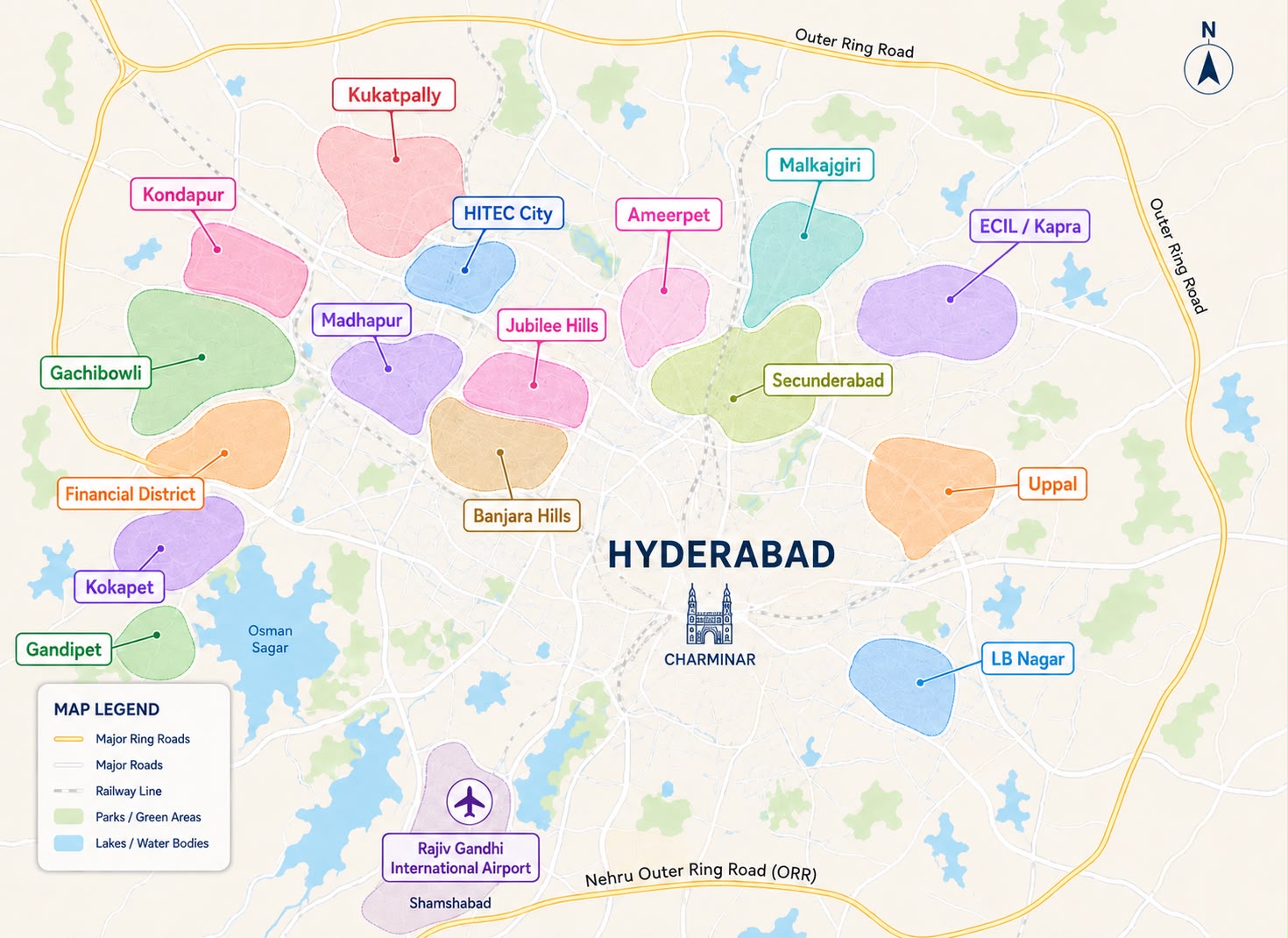
The IT corridor (west)
- HITEC City — the original tech campus cluster that started it all; still the anchor of Cyberabad.
- Gachibowli — the broader IT and education hub, home to the University of Hyderabad and the Indian School of Business, and the single biggest concentration of expat families.
- Madhapur — sits right against HITEC City, popular with younger professionals and startups.
- Kondapur — mixed residential and IT crowd, with one of the better everyday food and grocery scenes in the west.
- Financial District (Nanakramguda) — the newest cluster of corporate campuses and high-rises, still filling in around the edges.
- Kokapet — the newest wave of upscale villa communities and the Neopolis extension of the Financial District.
- Gandipet — quieter and greener, built around Osman Sagar lake; more of a weekend escape than a daily commute.
- Kukatpally — an older, more budget-friendly residential and retail hub just north of the IT corridor.
Central Hyderabad
- Jubilee Hills — upscale, leafy, and central, with the city's best-known restaurants, nightlife, and a fair number of film-industry residents.
- Banjara Hills — Jubilee Hills' equally upscale neighbor, organized by numbered roads, home to consulates and high-end dining.
- Ameerpet — a dense hub for coaching institutes and budget housing, and a major Metro interchange.
Secunderabad and the east
- Secunderabad — technically Hyderabad's twin city, built up as a British cantonment town, with its own historic core and major railway junction.
- Malkajgiri — a growing residential suburb just north of Secunderabad.
- ECIL / Kapra — named for the state-run Electronics Corporation of India, historically an engineering and public-sector residential area.
- Uppal — an eastern residential and industrial suburb, near the cricket stadium.
- LB Nagar — a major southeastern residential hub and a gateway toward the Nagarjuna Sagar highway.
The old city and beyond
- Charminar / Old City — the historic heart of Hyderabad, built around the original 1591 monument; home to the Laad Bazaar pearl and bangle markets, and the best-known biryani houses in the city.
- Shamshabad — south of the main city, where Rajiv Gandhi International Airport sits alongside a growing pharma manufacturing zone.
Culture, food, and festivals
Hyderabad's culture is a genuine blend of Hindu Telugu tradition and centuries of Muslim Deccani rule, visible in everything from its distinctive Hyderabadi Urdu dialect to its famously courteous, unhurried social manner, often called Hyderabadi tehzeeb.
The food is arguably the city's biggest export: Hyderabadi biryani, slow-cooked in a sealed pot in the dum style perfected under the Nizams, is the obvious headline act, but it's worth going deeper — haleem, a rich slow-cooked wheat and meat stew that takes over the city every Ramzan, and Irani chai paired with Osmania biscuits at one of the old-city's century-old Irani cafés, are just as essential.
The festival calendar reflects the same mix: Bonalu, a Telangana folk festival honoring the goddess Mahakali with processions of decorated offering pots, and Bathukamma, a flower festival celebrated mainly by women around the Dasara season, are both distinctly Telangana traditions you won't see the same way anywhere else in India. Alongside them, Ganesh Chaturthi immersions, Ramzan and Eid celebrations (especially vivid in the Old City), and Diwali all get celebrated with equal enthusiasm.
If you only build one food tradition into your calendar, make it haleem during Ramzan — it's sold at stalls all over the city for about six weeks a year and genuinely tastes different from the pre-packaged version available the rest of the year.
Add your community's favorite festival experiences, food tours, or cultural events here.
History, population, and administrative facts on this page are drawn from the following public sources, current as of when this page was last written. Figures like population and municipal boundaries shift over time, so treat these as a starting point rather than a live feed.
- Wikipedia — History of Hyderabad
- Wikipedia — Hyderabad
- Wikipedia — Demographics of Hyderabad
- Wikipedia — Greater Hyderabad Municipal Corporation
- Wikipedia — Hyderabad Metropolitan Region
- UNESCO — The Qutb Shahi Monuments of Hyderabad
- Macrotrends — Hyderabad Metro Area Population
- India Brand Equity Foundation — Telangana Industrial Development